Did you know that the average professional loses nearly two hours every single day to distractions and poor planning? This staggering loss of time often stems from a reactive approach to daily demands rather than a structured strategy.
When you learn to prioritize your to-do list fast, you reclaim control over your professional life. Shifting from a state of constant firefighting to a proactive mindset is the secret to reducing stress and boosting output.
Effective time management is not about doing more things; it is about doing the right things. By implementing simple, actionable habits, you ensure that your most important goals receive the focus they deserve. You will find that clarity leads to better results and a much calmer workday.
Key Takeaways
- Understand the hidden cost of daily distractions on your productivity.
- Shift from a reactive mindset to a proactive planning approach.
- Reduce workplace stress by organizing tasks with clear intent.
- Focus on high-impact goals to achieve better professional outcomes.
- Implement simple strategies to regain control of your schedule.
The Psychology Behind Why We Struggle with Prioritization
Why does the human mind naturally gravitate toward easy tasks instead of high-impact projects? Often, we feel a false sense of accomplishment when we clear small, trivial items from our list. This happens because our brains crave the quick dopamine hit that comes from checking off simple boxes, even when those tasks do not move the needle on our long-term goals. Mastering effective prioritization techniques requires us to recognize this biological bias toward immediate gratification.
Dwight D. Eisenhower famously captured this internal conflict by reflecting on the words of a university president. He noted a fundamental divide in how we perceive our daily challenges.
“I have two kinds of problems, the urgent and the important. The urgent are not important, and the important are never urgent.”
This observation highlights why we often fail to focus on what truly matters. We are conditioned to react to the loudest, most immediate demands, which creates a cycle of constant reactivity. By relying on proven priority setting techniques, you can break free from this reactive loop. Strategic planning allows you to shift your focus from merely “being busy” to achieving meaningful results that align with your core objectives.
How to Prioritize Your To-Do List Fast
You can regain control of your day by learning how to prioritize your to-do list fast. Many people feel overwhelmed because their tasks are scattered across sticky notes, emails, and digital apps. The first step toward clarity is consolidating every commitment into a single, reliable source of truth.
Once you have a master list, you must analyze each item with a critical eye. Ask yourself which tasks truly move the needle on your long-term goals. These are the items that deserve your immediate attention and energy.

Some tasks will inevitably fall into the category of low-impact busywork. Do not be afraid to delete or defer these items to clear mental space. Effective productivity tips often emphasize that what you choose not to do is just as important as what you complete.
“The key is not to prioritize what’s on your schedule, but to schedule your priorities.”
By following these streamlined steps, you can quickly narrow your focus to the most essential work. This method helps you prioritize your to-do list fast without the usual stress of decision fatigue. Implementing these simple productivity tips will transform your daily workflow and help you achieve more with less effort.
The Eisenhower Matrix for Strategic Decision Making
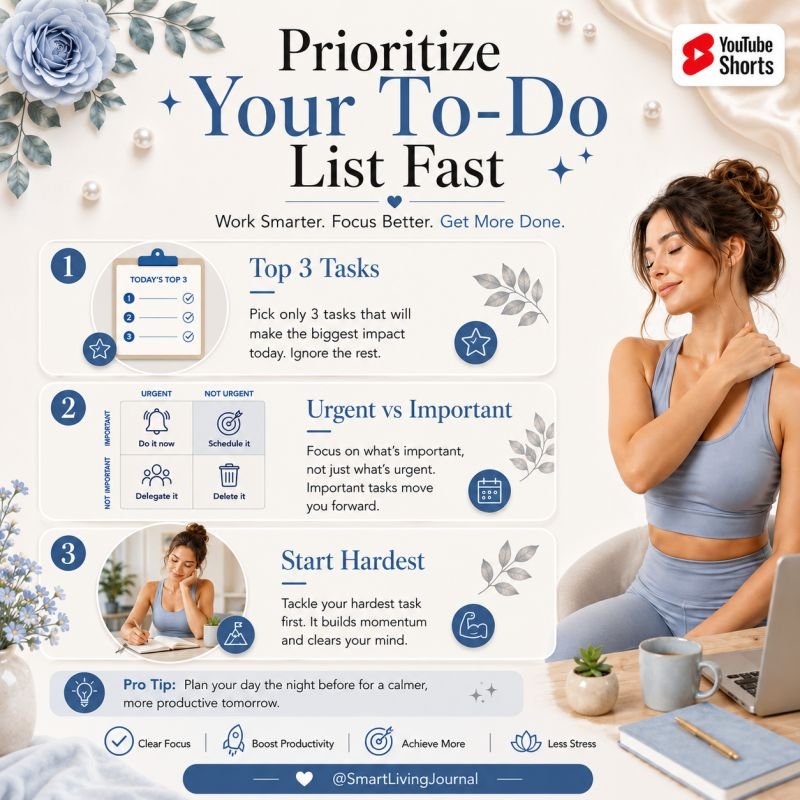
The Eisenhower Matrix offers a proven framework to help you regain control over your busy day. By categorizing your responsibilities, you can move away from reactive habits and toward proactive planning. This approach is one of the most effective time management strategies available for modern professionals.
Distinguishing Between Urgent and Important Tasks
To prioritize work tasks effectively, you must first understand the difference between urgency and importance. Urgent tasks demand your immediate attention, often because they have looming deadlines or external pressures. These items create a sense of constant motion but do not always move the needle on your long-term goals.
Important tasks, on the other hand, are those that contribute directly to your mission, values, and high-level objectives. While they may not always scream for your attention, they are the activities that drive meaningful progress. Learning to distinguish between these two categories is the secret to high-level productivity.
Applying the Four Quadrants to Your Daily Workflow
Once you categorize your to-do list, you can apply the four quadrants to streamline your daily workflow. This system forces you to make hard choices about where your energy goes. By using these time management strategies, you ensure that your most valuable hours are spent on high-impact work.
| Quadrant | Action | Task Type |
|---|---|---|
| Quadrant 1 | Do First | Urgent and Important |
| Quadrant 2 | Schedule | Not Urgent but Important |
| Quadrant 3 | Delegate | Urgent but Not Important |
| Quadrant 4 | Delete | Neither Urgent nor Important |
When you prioritize work tasks using this matrix, you stop wasting time on busywork that yields little return. Focus your energy on Quadrant 2 to prevent future crises, and delegate or delete the rest. This disciplined approach will transform how you manage your professional life.
Mastering the ABCDE Method for Daily Planning
You can transform your productivity by learning how to rank your tasks using the proven ABCDE framework. This system provides a structured approach to efficient task management, ensuring that you always know exactly what requires your immediate attention. By applying a simple value to every item on your list, you remove the guesswork from your workday.

Assigning Values to Your Tasks
To prioritize daily tasks effectively, you must assign a letter to each item based on its importance and consequences. This process forces you to evaluate the impact of your work rather than just the volume of your to-do list.
| Letter | Definition | Impact |
|---|---|---|
| A | Must do | Serious consequences |
| B | Should do | Mild consequences |
| C | Nice to do | No consequences |
| D | Delegate | Save time |
| E | Eliminate | Remove entirely |
Once you have assigned these values, you gain a clear roadmap for your day. You will quickly see which items deserve your focus and which ones are merely distractions. This clarity is the foundation of efficient task management.
The Discipline of Completing A-Tasks First
The true power of this method lies in your commitment to your “A” items. You must develop the discipline to finish your most critical tasks before you even consider moving to a “B” or “C” task. This habit prevents you from falling into the trap of doing easy, low-value work just to feel busy.
- Start your morning by identifying your top “A” task.
- Work on that task until it is fully complete.
- Avoid the temptation to check emails or messages until your primary goal is met.
When you consistently prioritize daily tasks in this order, you ensure that your most important objectives move forward every single day. Even if you only finish one “A” task, you have made significant progress toward your long-term goals. Stay focused, stay disciplined, and watch your output grow.
Time Blocking Techniques to Protect Your Focus
Protecting your focus requires more than just willpower; it demands a structured approach to your calendar. Many professionals find that their day disappears into a blur of reactive tasks and constant notifications. By implementing effective prioritization techniques, you can reclaim your time and ensure that your most important goals receive the attention they deserve.
Creating Dedicated Windows for Deep Work
Deep work is the ability to focus without distraction on a cognitively demanding task. To achieve this, you must carve out specific blocks of time in your schedule where you do not allow any outside interference. This practice helps you avoid the trap of reacting to every incoming email or message that hits your inbox.
When you commit to these windows, you are essentially telling yourself that this time is non-negotiable. Consistency is key to making this habit stick. By treating these blocks like high-priority meetings with yourself, you significantly increase your output and quality of work.
Handling Interruptions During Scheduled Blocks
Even with the best plans, unexpected interruptions are bound to happen. The secret to maintaining your flow is having a strategy to manage these distractions without losing your momentum. One of the most useful productivity hacks is to keep a “distraction list” nearby to jot down sudden thoughts or requests that pop up during your deep work session.
Once your block is finished, you can address those items during a designated period. If a colleague approaches you, politely explain that you are in the middle of a focused task and offer to connect later. Using these simple yet powerful productivity hacks ensures that you stay in control of your day rather than letting others dictate your schedule.
Leveraging the Pareto Principle for Maximum Output
The secret to massive productivity often lies in doing less, not more. By applying the Pareto Principle, also known as the 80/20 rule, you can fundamentally change how you approach your daily schedule. This concept suggests that 80 percent of your desired results stem from just 20 percent of your total efforts.
Implementing these productivity tips allows you to stop spinning your wheels on trivial matters. Instead, you gain the clarity needed to focus on the work that truly moves the needle. When you align your energy with your highest-value tasks, you unlock a new level of efficiency.

Identifying the 20 Percent That Drives 80 Percent of Results
To start, you must audit your current workload to find those high-impact activities. Look for the specific tasks that consistently lead to your biggest wins or most significant progress. These are the core drivers of your success and deserve your undivided attention during your peak hours.
“Focus on being productive instead of busy.”
You can identify these tasks by tracking your time for a few days. Once you see the patterns, prioritize the following:
- Tasks that directly contribute to your primary goals.
- Projects that offer the highest return on your time investment.
- Activities that only you can perform effectively.
Eliminating Low-Impact Busywork
Once you identify your top 20 percent, you must ruthlessly cut the rest. Many productivity hacks focus on doing things faster, but the most effective strategy is often to stop doing unnecessary things altogether. Low-impact busywork acts as a drain on your mental energy and keeps you from your best work.
Consider delegating, automating, or simply deleting tasks that do not serve your long-term vision. By clearing your plate of these distractions, you create the space required for deep, meaningful output. Remember, every minute spent on low-value work is a minute stolen from your most important projects.
Digital Tools to Organize Tasks Effectively
In today’s fast-paced environment, relying on memory or paper notes is rarely enough to keep up with complex demands. Modern digital tools offer incredible opportunities to automate and organize tasks effectively, ensuring that nothing slips through the cracks. By leveraging the right technology, you can reclaim your time and focus on what truly matters.
Choosing the Right Task Management Software
Selecting the perfect application depends entirely on your specific workflow needs and personal preferences. You should look for platforms that offer intuitive interfaces, cross-device synchronization, and features that support your unique planning style. Whether you prefer a simple checklist or a complex project management board, there is a tool designed for you.
Consider these popular options to enhance your efficient task management:
- Todoist: Excellent for those who love clean, simple lists and natural language input.
- Asana: Ideal for managing larger projects and collaborating with team members.
- TickTick: A great all-in-one solution that includes a built-in Pomodoro timer and calendar view.
“The best tool is the one that you actually use consistently every single day.”
Syncing Your Calendar with Your To-Do List
One of the most effective ways to stay on track is to bridge the gap between your tasks and your time commitments. When you sync your calendar with your to-do list, you create a visual representation of your day that accounts for both meetings and deep work sessions. This integration prevents the common trap of over-scheduling your time.
By seeing your deadlines alongside your appointments, you can organize tasks effectively by assigning them to specific time blocks. This method ensures that your daily goals are realistic and achievable. Ultimately, this level of efficient task management provides the clarity needed to maintain high performance without burning out.
Overcoming Procrastination Through Micro-Tasking
When your to-do list looks like a mountain, the best way to climb it is one small step at a time. Many people find themselves stuck in a cycle of delay simply because they do not know where to begin. Learning to prioritize daily tasks by shrinking them down can change your entire outlook on productivity.

Breaking Down Overwhelming Projects
Large assignments often trigger a stress response that leads to avoidance. By using micro-tasking, you transform a vague, scary goal into a series of actionable items. Instead of writing “Finish Project Report,” try breaking it into “Outline sections,” “Draft introduction,” and “Format data tables.”
This method allows you to prioritize daily tasks with much greater clarity. When you focus on a single, tiny step, the mental barrier to starting disappears. You no longer have to worry about the entire project; you only need to worry about the next ten minutes of work.
“The secret of getting ahead is getting started. The secret of getting started is breaking your complex overwhelming tasks into small manageable tasks, and then starting on the first one.”
The Power of Small Wins to Build Momentum
Completing a small task provides an immediate sense of accomplishment. This positive reinforcement releases dopamine, which encourages you to tackle the next item on your list. These quick wins are essential when you need to prioritize daily tasks during a busy week.
As you check off these bite-sized goals, you build natural momentum that carries you through the day. What started as a daunting project eventually becomes a series of completed steps. You will find that consistency is far more effective than trying to finish everything in one massive, exhausting burst.
Managing Energy Instead of Just Time
Many professionals struggle because they treat their time like a fixed resource rather than a fluctuating battery. While traditional time management strategies focus on tracking every minute, true efficiency comes from understanding your personal rhythm. You cannot force high-level cognitive output when your internal fuel tank is running on empty.
Aligning Difficult Tasks with Your Peak Productivity Hours
Research shows that nearly 60% of time at work is spent on “work about work,” such as status updates and administrative tasks. To combat this, you must protect your best hours for deep, meaningful projects. Identify whether you are a morning lark or a night owl to maximize your impact.
Schedule your most demanding tasks during your peak windows of mental clarity. By tackling complex problems when your brain is sharpest, you reduce the time required to finish them. This approach is one of the most effective time management strategies for maintaining high quality output throughout the week.
Recognizing Signs of Mental Fatigue
Ignoring your body’s signals often leads to burnout and diminished returns. You might notice that you are re-reading the same email multiple times or feeling uncharacteristically irritable. These are clear indicators that your cognitive resources are depleted.
When you spot these signs, it is time to pivot to low-energy tasks or take a brief, restorative break. Stepping away from your desk for a few minutes can reset your focus and prevent errors. Prioritizing your well-being is not a sign of weakness; it is a strategic necessity for long-term success.
Setting Realistic Expectations for Your Daily Capacity
You might be surprised by how much more you accomplish when you stop overestimating your available time. Many professionals fall into the cycle of planning for a perfect day, only to find that reality rarely cooperates. By adjusting your mindset, you can prioritize work tasks with greater accuracy and less stress.

Avoiding the Trap of Over-Scheduling
A common mistake is assuming you can work at peak performance for eight hours straight. In reality, your brain needs downtime to function at its best. A helpful rule of thumb is to underestimate how much you can get done while simultaneously overestimating how long each task will take.
When you build in extra buffer time, you create a safety net for unexpected interruptions. This approach prevents the frustration that comes from looking at an incomplete list at the end of the day. Consistency is far more valuable than a single day of frantic, unsustainable output.
Learning to Say No to Non-Essential Requests
Your time is a finite resource that requires careful protection. Every time you say yes to a minor request, you are effectively saying no to your own high-priority goals. Learning to decline non-essential tasks is a critical skill for anyone who wants to maintain long-term focus.
When you need to prioritize work tasks, evaluate every new request against your current objectives. If a task does not move the needle on your primary goals, it is perfectly acceptable to decline or delegate it. By setting these boundaries, you ensure that your energy remains directed toward the work that truly matters.
Remember that saying no does not have to be rude or confrontational. You can be professional and firm while explaining that your current capacity is fully committed to other projects. This simple act of setting boundaries will help you regain control over your schedule and improve your overall quality of life.
Reviewing and Refining Your Prioritization System
A truly effective productivity system is never static; it requires constant care to remain useful. When you organize tasks effectively, you create a foundation for success, but that foundation needs regular maintenance to stay strong. Think of your workflow as a garden that needs consistent weeding and pruning to flourish.
Conducting Weekly Reviews for Long-Term Success
Setting aside time each week to look back at your performance is a game-changer. During this period, you should evaluate which tasks were completed and which ones slipped through the cracks. This intentional reflection allows you to identify patterns in your behavior and adjust your habits accordingly.
“Reflection is one of the most underused yet powerful tools for success.”
Use this time to clear your digital workspace and prepare for the upcoming week. By doing this, you ensure that you continue to organize tasks effectively without feeling overwhelmed by a backlog of unfinished business.
Adjusting Your Strategy Based on Changing Priorities
Life is unpredictable, and your to-do list should reflect that reality. If a project suddenly shifts in importance, do not be afraid to move it to a different quadrant or reassign its priority level. Flexibility is the key to maintaining momentum when circumstances change unexpectedly.
The following table outlines how to categorize your review process to ensure you stay on track:
| Review Stage | Focus Area | Action Required |
|---|---|---|
| Daily Check | Immediate Tasks | Clear urgent items |
| Weekly Audit | Project Progress | Refine long-term goals |
| Monthly Reset | System Efficiency | Update your tools |
By staying adaptable, you ensure that your daily actions remain aligned with your long-term vision. Remember that the goal is not to follow a rigid plan, but to organize tasks effectively in a way that supports your evolving needs and professional growth.
Conclusion
Taking control of your schedule requires a shift in mindset rather than just a new calendar app. You now possess the tools to filter out noise and focus on high-impact results. Consistent application of these priority setting techniques turns chaotic days into structured paths toward your goals.
Growth happens when you commit to small, daily improvements. You might start by auditing your current habits or testing a new planning method this week. Every adjustment you make builds the momentum needed for long-term success.
Refining your approach is a lifelong journey of self-discovery. As you gain clarity on what truly matters, your ability to execute tasks with precision will grow. Keep experimenting with different priority setting techniques to find the rhythm that fits your unique professional life.
Share your progress with peers or colleagues to stay accountable. Your journey toward peak productivity starts with the very next task on your list. Embrace the process and watch your output reach new heights.
FAQ
How can I prioritize my to-do list fast when I feel overwhelmed by a long list?
What are the most effective prioritization techniques for daily planning?
How can I organize tasks effectively using digital tools?
Do you have any productivity tips for staying focused throughout the day?
How can I better prioritize work tasks without over-scheduling my day?

SmartLivingJournal
Prabir Dutta is a passionate digital creator, affiliate marketer, and wellness enthusiast who simplifies complex topics like AI tools, Vastu, pet care, and modern living. With a keen eye for SEO, tech trends, and everyday health solutions, he writes to empower readers with actionable, smart-living insights. When not curating content across his network of niche blogs, Prabir enjoys exploring new digital tools that make life easier and more efficient.
Keep exploring Smart Living Journal
Discover more practical ideas on wellness, home living, plants, pets, routines, and smarter everyday upgrades.