Thoughtfully presented content from Smart Living Journal, designed to support clearer decisions and a better everyday lifestyle.
Modern life offers incredible opportunities, but it also introduces an invisible challenge: constant distraction.
Notifications appear every few minutes. Social media feeds compete for attention. Emails, messages, and endless online information create a continuous stream of interruptions.
Many people feel busy throughout the day yet struggle to complete meaningful work.
Focus and productivity are not simply personality traits that some individuals naturally possess. They are skills that can be developed and environments that can be designed intentionally.
By understanding how attention works and implementing practical strategies, anyone can dramatically improve their ability to concentrate and produce meaningful results.
This guide explores the science behind focus, the hidden costs of distractions, and practical methods to build stronger productivity habits in a world that constantly competes for attention.
Before diving deeper into the strategies, here are a few important ideas to keep in mind:
The human brain evolved in environments where information was scarce. Attention needed to shift quickly to detect threats or opportunities.
Today the situation is completely different.
We live in a world filled with:
Each of these sources competes for our attention.
Digital platforms are also designed to keep users engaged. Notifications, recommendation algorithms, and infinite scrolling feeds encourage repeated interaction.
While these tools can be useful, they also fragment attention and make sustained focus increasingly difficult.
This phenomenon is known as attention fragmentation, where individuals repeatedly switch between tasks without fully concentrating on any of them.
Focus is controlled largely by the prefrontal cortex, a region of the brain responsible for planning, decision-making, and attention control.
When we concentrate on a task, the brain allocates cognitive resources to that activity while suppressing irrelevant stimuli.
However, when a distraction occurs, the brain must redirect its attention. Each shift requires additional mental effort.
Studies suggest that it can take more than 20 minutes to regain full concentration after a distraction.
There are two main forms of attention:
This type of attention requires deliberate effort. It is used when reading, writing, studying, or solving problems.
Automatic attention is triggered by stimuli such as sounds, notifications, or visual movement.
Many modern distractions exploit this automatic attention system, which explains why it is so easy to lose focus.
Distractions do not simply interrupt work. They create a series of hidden consequences that accumulate throughout the day.
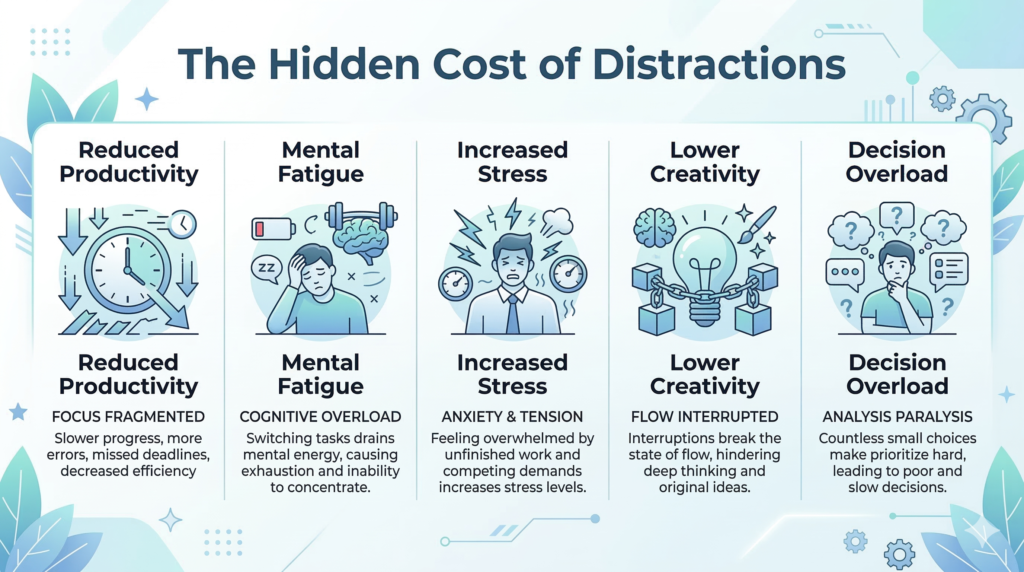
These consequences can significantly reduce both productivity and mental clarity.
Reducing distractions therefore improves not only work performance but also overall mental well-being.
Many people unknowingly follow habits that undermine their ability to focus.
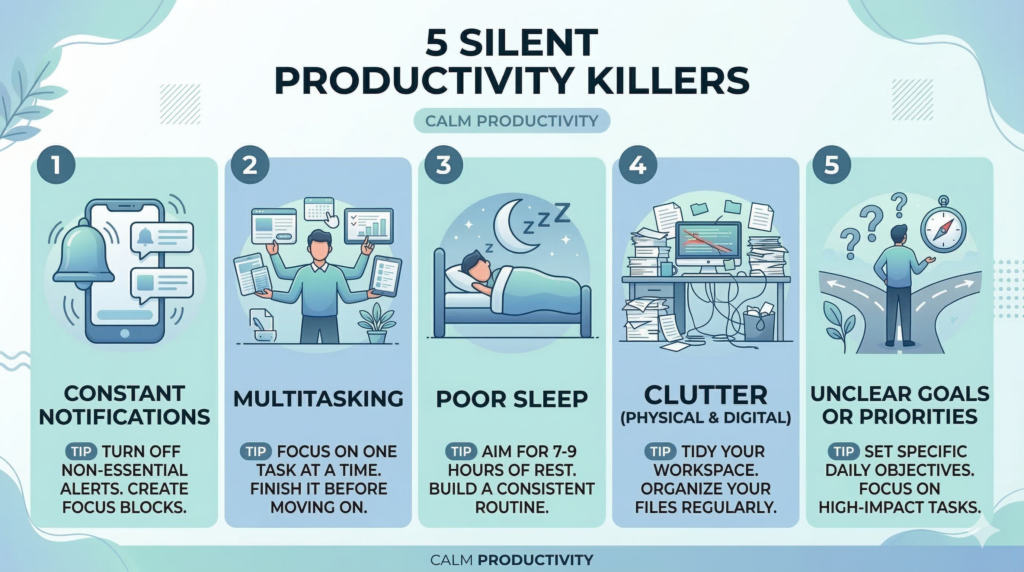
These behaviors often appear harmless but significantly reduce productivity over time.
Many individuals believe multitasking improves efficiency. In reality, the brain switches rapidly between tasks rather than performing them simultaneously.
Smartphones are one of the most powerful attention disruptors. Even the presence of a phone nearby can reduce cognitive performance.
When tasks are unclear, the brain struggles to prioritize effectively.
Continuous work without breaks leads to mental fatigue and declining productivity.
Visual clutter competes for attention and increases cognitive load.
Fortunately, several simple techniques can dramatically improve concentration.
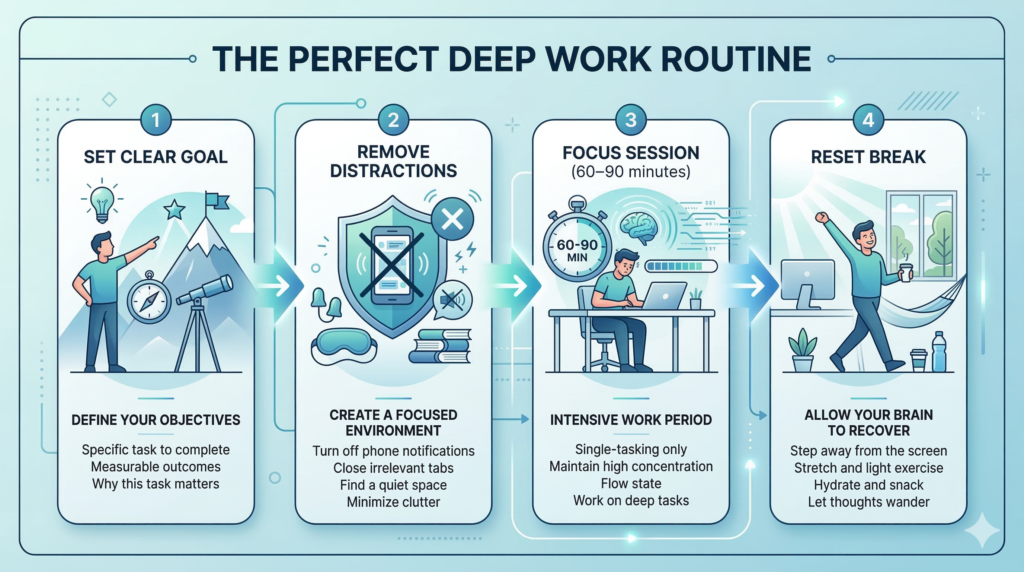
The key is consistency rather than complexity.
This method divides work into structured intervals.
Typical structure:
After four cycles, take a longer break.
This technique prevents burnout and helps maintain concentration.
Time blocking involves assigning specific time periods to particular tasks.
Rather than reacting to tasks throughout the day, individuals schedule when each activity will occur.
Deep work refers to uninterrupted periods dedicated to cognitively demanding tasks.
During deep work sessions:
Even one deep work session per day can significantly improve productivity.
Focus is strongly influenced by daily lifestyle habits.
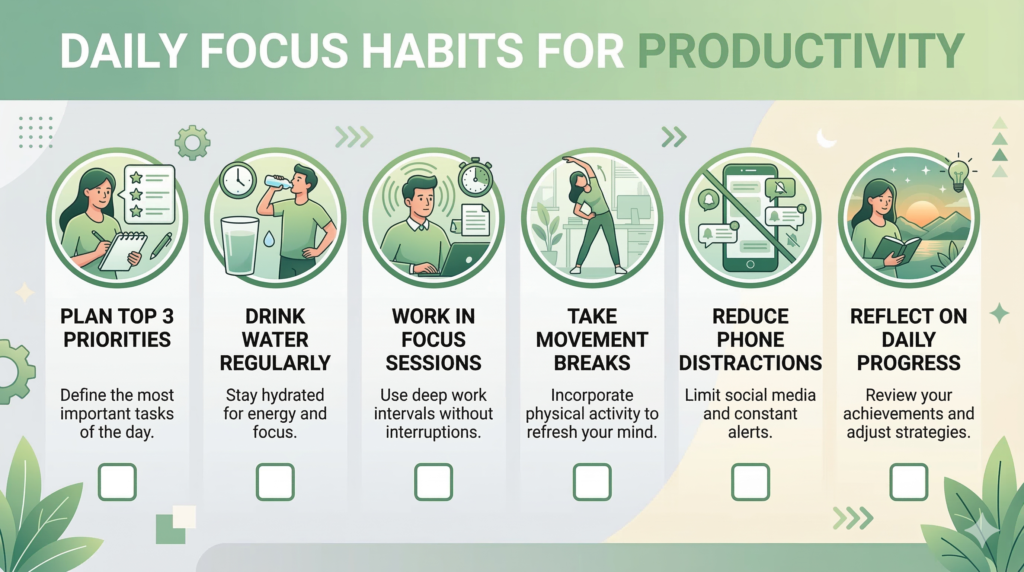
Improving these habits helps maintain sustained productivity.
Sleep restores cognitive function and strengthens memory.
Movement improves blood flow to the brain and increases alertness.
Even mild dehydration can reduce mental performance.
Starting the day with clear priorities helps maintain direction.
Limiting screen time outside work hours protects mental energy.
A well-designed workspace can dramatically improve concentration.
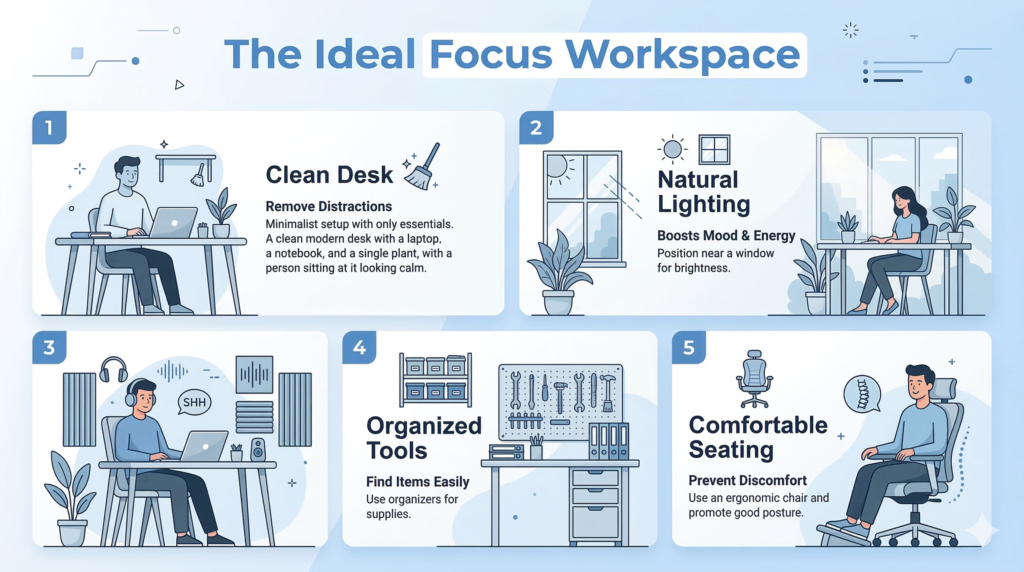
Environment influences productivity more than many people realize.
Key elements of a productive workspace include:
When the environment supports focus, the brain requires less effort to maintain attention.
Many productivity systems fail because they attempt too many changes at once.
Instead, build productivity gradually.
Start with small habits, maintain consistency, evaluate progress regularly, and adjust routines as necessary.
Over time these small improvements compound into powerful productivity systems.
Sustaining focus requires more than short-term motivation.
Long-term productivity improves when individuals:
Focus is not about constant work but about intentional attention and meaningful progress.
Focus and productivity are essential skills in a world filled with distractions.
Rather than relying on willpower alone, the most effective approach involves designing habits, environments, and routines that naturally support concentration.
By applying the strategies in this guide, individuals can regain control of their attention, reduce stress, and accomplish meaningful work with greater clarity.
Small improvements in focus today can lead to significant long-term results.